
Your EMI share option scheme, set up and run in one place
Set up an Enterprise Management Incentive (EMI) share scheme, grant employee share options and track every vesting schedule and leaver. Your option pool stays live on your fully diluted cap table, with SuLe lawyers on hand for anything bespoke.
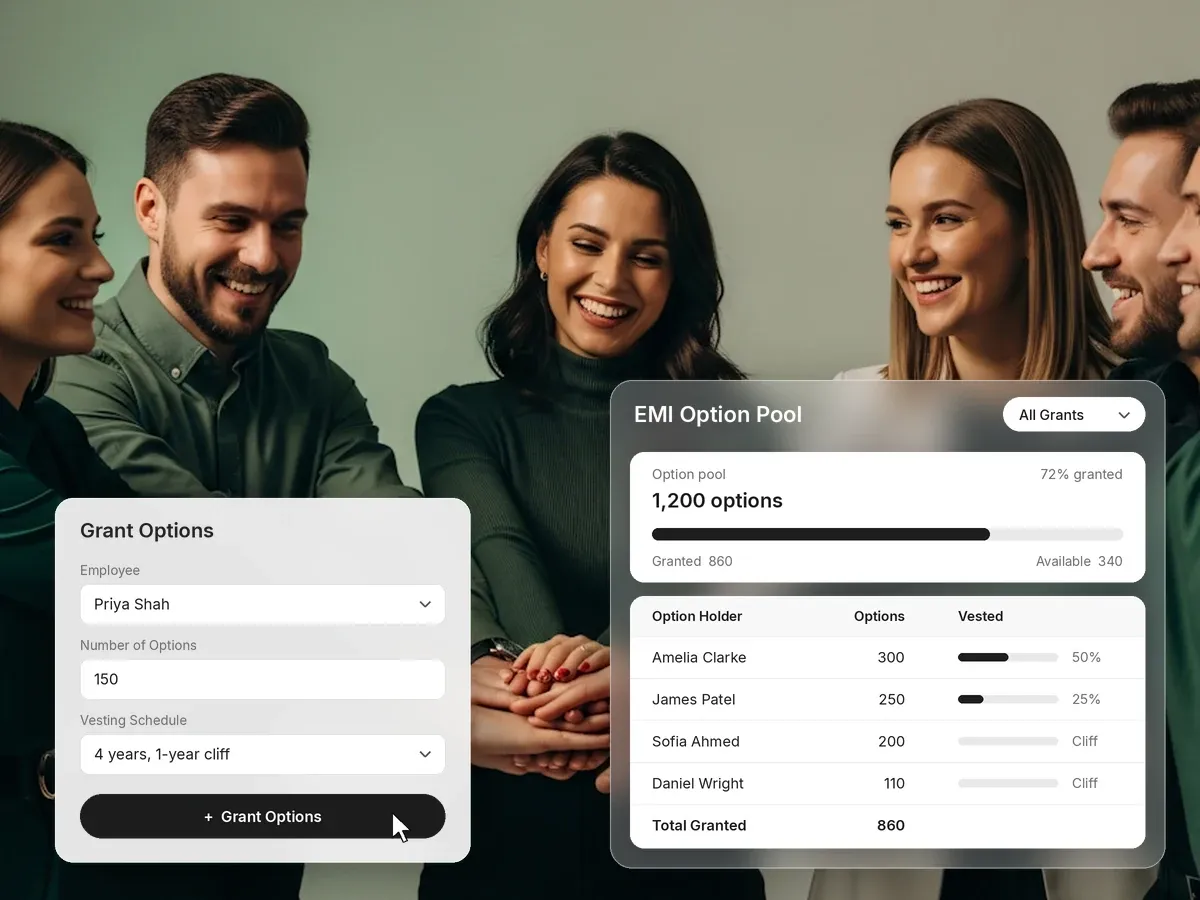
Your share option scheme, from set-up to cap table
1
Set up your EMI scheme
Set up your staff share option scheme in six steps, from the eligibility check to registering with HMRC, with lawyer-built documents ready to sign.
2
Grant options and track vesting
Grant options to your team, follow every vesting schedule and handle leavers in one place, not in a spreadsheet.
3
See the pool on your cap table
Every grant lands on your fully diluted cap table, so you always know how much of the option pool is left before your next round.
How to set up an EMI scheme
Check EMI eligibility.
Confirm your company and each employee meet HMRC's EMI qualifying conditions, including the higher limits in force since 6 April 2026.
Agree an EMI valuation.
Agree the market value of your shares with HMRC on form VAL231 before you grant, so the exercise price holds up.
Adopt the EMI scheme rules.
Set vesting, leaver terms and exercise events once, so every grant follows the same rules.
Issue EMI option agreements.
Prepare an option agreement for each employee from the scheme rules, ready to sign online.
Get board approval.
Approve the scheme and each grant with board minutes, kept with the rest of your company records.
Report to HMRC.
Register the scheme with HMRC, report grants as the rules require and file your employment-related securities return by 6 July each year.
Employee share options, tracked from grant to exercise
Every grant in one place.
Who holds what, at which exercise price, under which option agreement.
Vesting schedules, worked out for you.
See what has vested and what is still to come for every option holder.
Good and bad leavers, handled properly.
Apply good leaver and bad leaver terms, and return lapsed options to the pool.
See your option pool on the fully diluted cap table
Granted, vested and unallocated options sit next to every other shareholder, so you know what the pool costs before your next round. Model a pool top-up in the Round Simulator before you agree terms with investors.

Need more than a standard EMI scheme?
Get EMI scheme legal advice from SuLe lawyers for anything bespoke: exit-only or performance vesting, EMI2 (formerly CSOP), growth shares, or unapproved options for advisers. Your plan includes monthly lawyer time; anything beyond it is a fixed fee agreed first.
Employee share schemesEMI scheme questions founders ask us
Since 6 April 2026, a company can grant EMI options if it's independent, has gross assets of £120 million or less and fewer than 500 full-time equivalent employees, and has a UK permanent establishment and a qualifying trade. Some activities, like banking and farming, are excluded. If you don’t qualify, EMI2 (formerly CSOP) is open to companies of any size.
If an employee exercises at no less than the market value when the option was granted, and within the option period, there's no income tax or National Insurance to pay. When they sell the shares, any gain faces capital gains tax, and Business Asset Disposal Relief may lower the rate. Your company may also get a corporation tax deduction.
It isn't compulsory, but it's strongly recommended. Agreeing the market value of your shares with HMRC on form VAL231 before you grant fixes the exercise price with certainty. Without it, HMRC can challenge the value later, and investors' due diligence will ask how you set it.
It depends on your scheme rules and option agreements. Many startups treat good leavers more generously than bad leavers, for example letting good leavers keep vested options while unvested ones lapse. Under EMI, options exercised more than 90 days after employment ends lose their EMI tax advantages, so the exercise window matters.
No. EMI options can only go to employees, including full-time directors, who work at least 25 hours a week for the company, or 75% of their working time if less. Contractors, advisers and non-executive directors can get unapproved options instead, which a SuLe lawyer can set up.
There's no fixed rule. Many seed-stage startups set aside 10% to 15% of fully diluted shares, and investors often ask for the pool to be created or topped up before they invest, so the dilution falls on existing shareholders. Model both cases in the Round Simulator before you agree terms.
Give your team a stake in what they're building
Set up your EMI share option scheme next to your cap table, and bring in a SuLe lawyer only when you need one.