
Know exactly who owns what. Before your investors ask.
Free, and built for UK founders raising now. Start from your Companies House record or the spreadsheet you already keep.
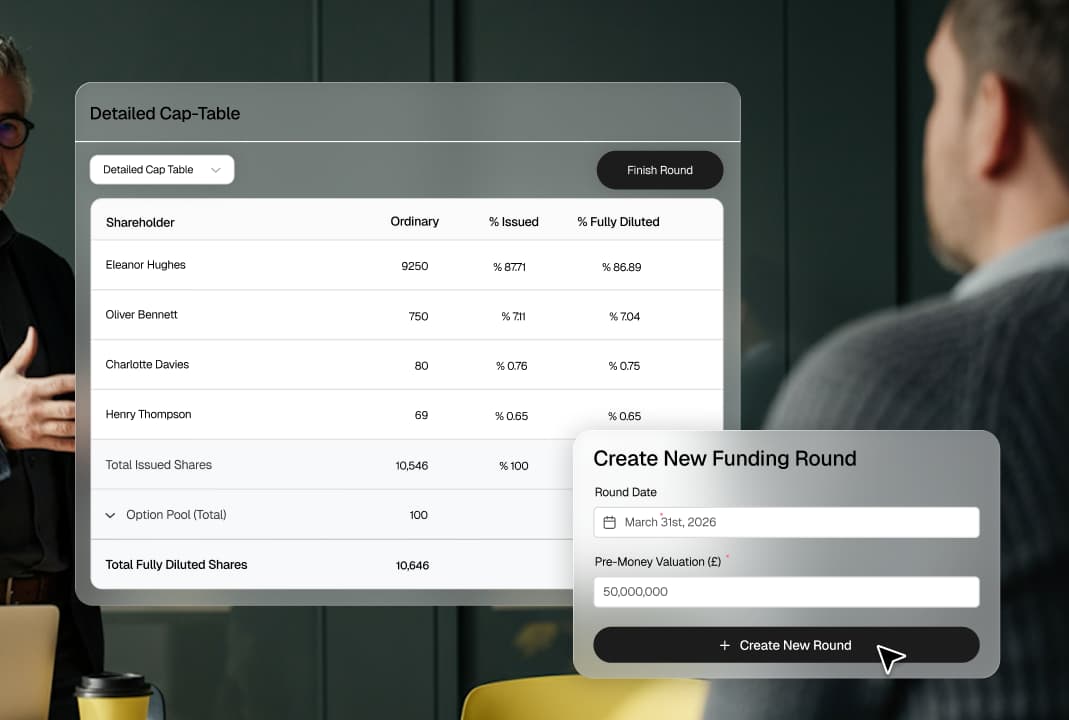
Have an investor-ready cap table in 3 steps
1
Import your company's details
You can extract your details directly from Companies House or import an existing cap table.
2
Add any additional information
Start to add your convertibles, option holders and update any information.
3
Share your investor-ready cap table
Once complete, export your cap table, ready in a format that your investor needs to start their DD.
Built for how UK rounds actually work
Investor ready.
One source of truth for shares, convertibles and options.
Convertibles, fully supported.
Advance subscription agreements, convertible notes and SAFEs, with their discounts, caps and longstop dates.
Option holders by name, not a number in a box.
Create your pool and track every grant in the same place.
Start from the real record.
Pull your details straight from Companies House, or upload the spreadsheet you already keep.
The number investors actually ask for.
Issued and fully diluted in one view, one toggle.
Free, and nothing is locked in.
Export a clean Excel copy whenever you want.
What does your ASA actually turn into?
You raised on an advance subscription agreement eighteen months ago and you have been guessing ever since. Put in a valuation and see the shares it becomes, next to everything else you own.
| Shareholder | Shares | % |
|---|---|---|
| Eleanor Hughes | 6,000 | 60.00% |
| Oliver Bennett | 2,500 | 25.00% |
| Charlotte Davies | 1,000 | 10.00% |
| Henry Thompson | 500 | 5.00% |
| Advance subscription agreement£250,000, not yet converted | — | — |
Same table. No separate tab.
See what a round does to your ownership.
Drag the sliders. The numbers update live.
Most term sheets ask for the pool to be created pre-money — that means existing shareholders (including you) absorb it. You can set it to 0 if no pool is being created this round.
This is the simple maths. Check the real numbers.
Sign up for free to create your real cap table, with information pulled directly from Companies House.
Run it on my real cap tableThis round costs you 18.0% of your company
(from 60.0% to 42.0%)
The things founders ask us
What is a cap table?
The record of who owns what in your company. It lists every shareholder, how many shares they hold, what class those shares are, and what percentage that represents — both as issued today and fully diluted once options and convertibles are counted.
Can I import a cap table I already have?
Yes. Start from your Companies House record, or upload the spreadsheet you already keep and we turn it into a structured record. You do not start from a blank page.
Is it really free?
Yes. Add as many shareholders and option holders as you need and export to Excel whenever you want, without paying and without a trial that expires. Paid plans add templates, e-signatures and included lawyer time.
Do you support ASAs, convertible loan notes and SAFEs?
Yes, fully. Track longstop dates, discounts, valuation caps and interest rates, so your fully diluted numbers stay right before anything converts.
Can I track option grants?
Yes. Create your pool and track every grant by name, with exercise price and vesting terms, rather than carrying the whole pool as one line.
What is the difference between issued and fully diluted share capital?
Issued share capital is the shares that exist today. Fully diluted also counts your option pool and anything your convertibles will turn into, and it is the number investors usually ask for. Both are in one view, one toggle.
What if I need an actual lawyer?
You can connect to one from inside SuLe, and they work from the same cap table rather than asking you to send a spreadsheet. Paid plans include Legal Advice credits every month: 50 on Start (about 15 minutes with a senior lawyer) and 150 on Pro (about 45 minutes).
How many shares should we issue at incorporation?
Any number works and the legal minimum is one, but a round figure like 100,000 keeps the maths readable: 1% is a clean 1,000 shares. The share count does not change what the company is worth.
How many shares should I issue when incorporating a UK startup?
How should co-founders split the equity?
Deliberately, after talking through contribution, capital and who is full-time. An equal split should be a decision rather than a default, and whatever you agree, the register of members is the legal record — not a spreadsheet or a handshake.
How big should our option pool be?
Around 10% of fully diluted shares is a common seed figure, growing to 10–15% by Series A. Size it against your next 18 to 24 months of hiring, role by role, rather than picking a round number.
Does the option pool come out before or after the investment?
It matters more than it sounds. A pre-money pool dilutes only the existing shareholders, so your effective valuation is lower than the headline figure. A post-money pool dilutes the new investor too.